
Prototype to Production CNC Machining: A Buyer’s Guide to Scaling Without Quality Problems
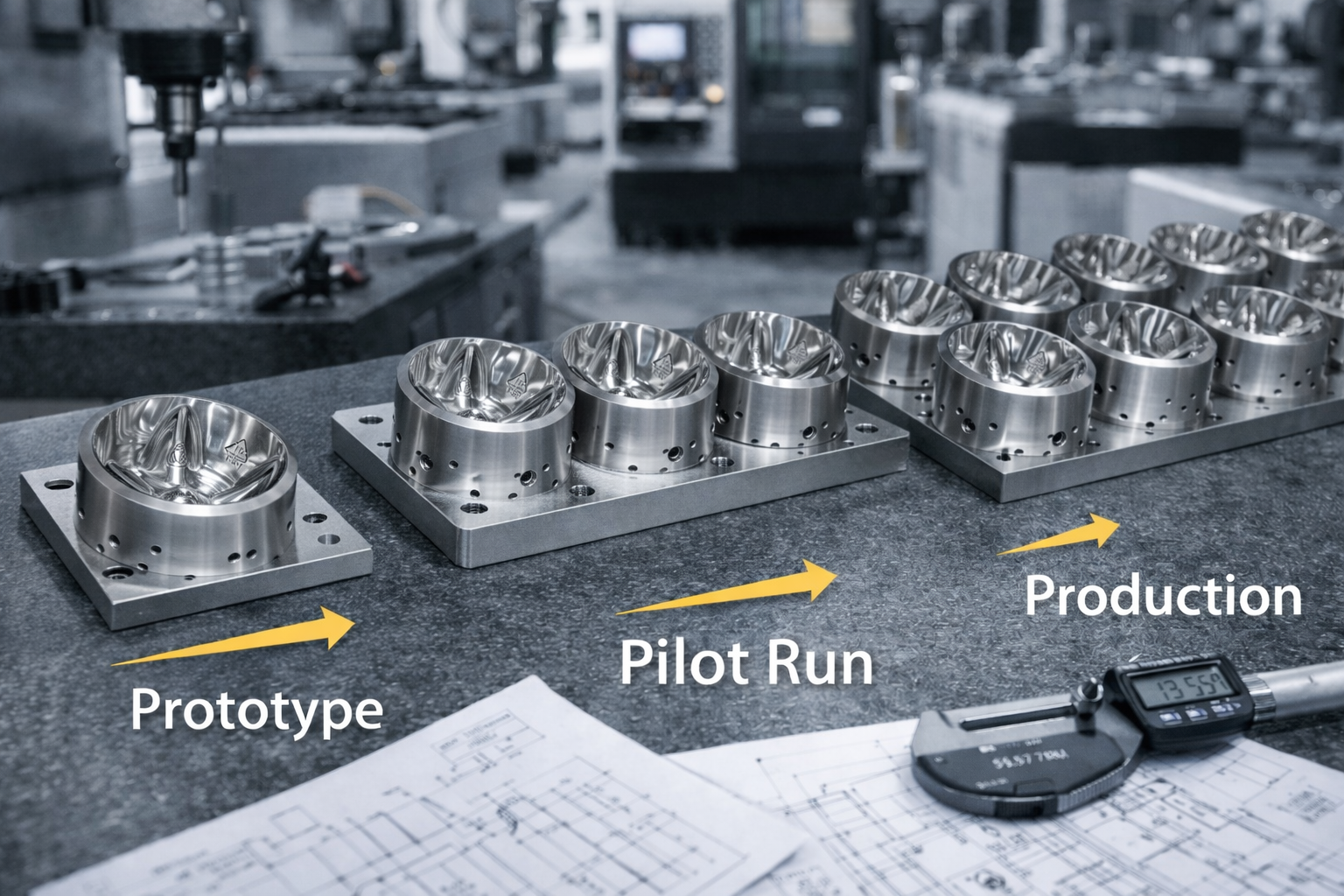
Many suppliers can make a prototype. Far fewer can take a part from prototype to production while keeping dimensions consistent, lead times stable, and costs predictable.
We are a CNC shop in Varna, Bulgaria with milling, turning, and 5-axis machining capabilities in aluminum, stainless steels, and tool steels, producing both prototypes and production parts (typical size up to ~400–600 mm).
Here we explain what changes when you scale—and what to ask us before you commit to production.
What’s different between a prototype and a production part?
A prototype often focuses on “does it work?”
Production focuses on:
-
repeatability across batches
-
stable setups and cycle times
-
predictable lead time
-
controlled inspection strategy
-
cost reduction without changing function
A shop that is good at production will invest in process, not just machining.
Step 1: Prototype phase—build the part and learn fast
In prototyping, speed matters.
The best CNC shops will:
-
run a quick DFM ( DFM = Design for Manufacturability) review (catch risks before cutting metal)
-
confirm critical-to-function dimensions
-
suggest changes that reduce cost or risk (radii, tolerances, tool access)
-
deliver a clean first article and feedback for revision
Prototype RFQ essentials
-
PDF + STEP
-
quantity (often 1–5 pcs)
-
material grade
-
what you’re testing (fit, strength, sealing, motion, heat)
Step 2: Pilot run—prove the process, not just the part
A pilot batch (e.g., 10–50 pcs) is where you validate:
-
fixture stability
-
tool wear behavior
-
cycle time repeatability
-
inspection method
-
yield (scrap rate)
What to ask for during a pilot run
-
identified critical dimensions and measurement method
-
a basic inspection report / first article verification
-
notes on process stability (what could vary and why)
This is where many projects fail—because the prototype worked, but the process was never proven.
Step 3: Production—reduce variation and control cost
In production, cost and consistency come from:
Standardized fixturing and setups
Repeatable soft jaws/fixtures reduce variation and operator dependence.
Tooling plan and wear control
Especially in stainless/tool steels, wear affects size and surface finish. Controlled tool changes + offsets keep parts consistent.
Locked process for critical features
Critical dimensions are measured in-process and at final inspection based on an agreed plan.
5-axis strategies to reduce setups
For parts with multiple faces and positional relationships, 5-axis machining can reduce re-clamping and improve consistency.
Managing engineering changes without chaos
Revisions happen. A good supplier will have a simple process:
-
clear revision control (which drawing version is being machined)
-
defined “stop and confirm” points for critical changes
-
documentation updates if inspection requirements change
If you expect changes, say so early—especially if you’re scaling fast.
RFQ checklist for scaling prototype to production
Send:
-
PDF drawing + STEP
-
quantity forecast (now + later)
-
material and finish
-
delivery target (dates)
-
critical dimensions / functional stack-ups
-
documentation needs (FAI, measurement reports)
A supplier can price better when they understand the roadmap (prototype → pilot → production).
Prototype to production CNC machining in Varna, Bulgaria
We provide:
-
CNC milling, turning, 5-axis machining
-
Materials: aluminum, stainless steels, tool steels
-
Prototype builds and repeat production
-
Typical part size up to ~400–600 mm
Request a quote: send your RFQ with PDF + STEP, quantities (now and later), material, finish, and target date. We’ll respond with a plan that supports both prototype speed and production repeatability.